
Youth Bat Size Chart
The right bat helps young players swing with control and confidence. This printable pack gives you a youth bat size chart by age, height and weight, three quick at-home fit tests, a guide to drop weight and league bat standards, and a team bat log for coaches — so you can shortlist the right length and weight before buying.
- Instant download
- Editable Excel & Word
- Print-ready PDF
- 7-day refund
Quick answer
Use a bat size chart as a starting point, not the final answer. For most youth baseball and softball players, match the player’s age to a typical bat length, then confirm the choice with chest, arm and one-hand weight tests. Tee ball players usually start around 24–26 inches (61–66 cm).
6 files · PDF, XLSX, DOCX
Youth Bat Size Chart Pack
Printable youth baseball and softball bat size charts by age and height, fit test cards, a drop weight and league standards reference, and an Excel team bat log.
- By age (PDF)
- By height (PDF)
- Fit test cards (PDF)
- + 3 more
$5.00 USD, one-time 6 files · about $0.83 each
- Instant download
- 7-day refund
- Secure checkout by Stripe
7-day money-back guarantee. Full refund within 7 days of purchase, even after you download.
Free sample: Youth Bat Size By Age (PDF, 62 KB)
Youth Bat Size Chart Pack
Printable youth baseball and softball bat size charts by age and height, fit test cards, a drop weight and league standards reference, and an Excel team bat log.
- By age (PDF)
- By height (PDF)
- Fit test cards (PDF)
- Standards reference (PDF)
- Softball chart (PDF)
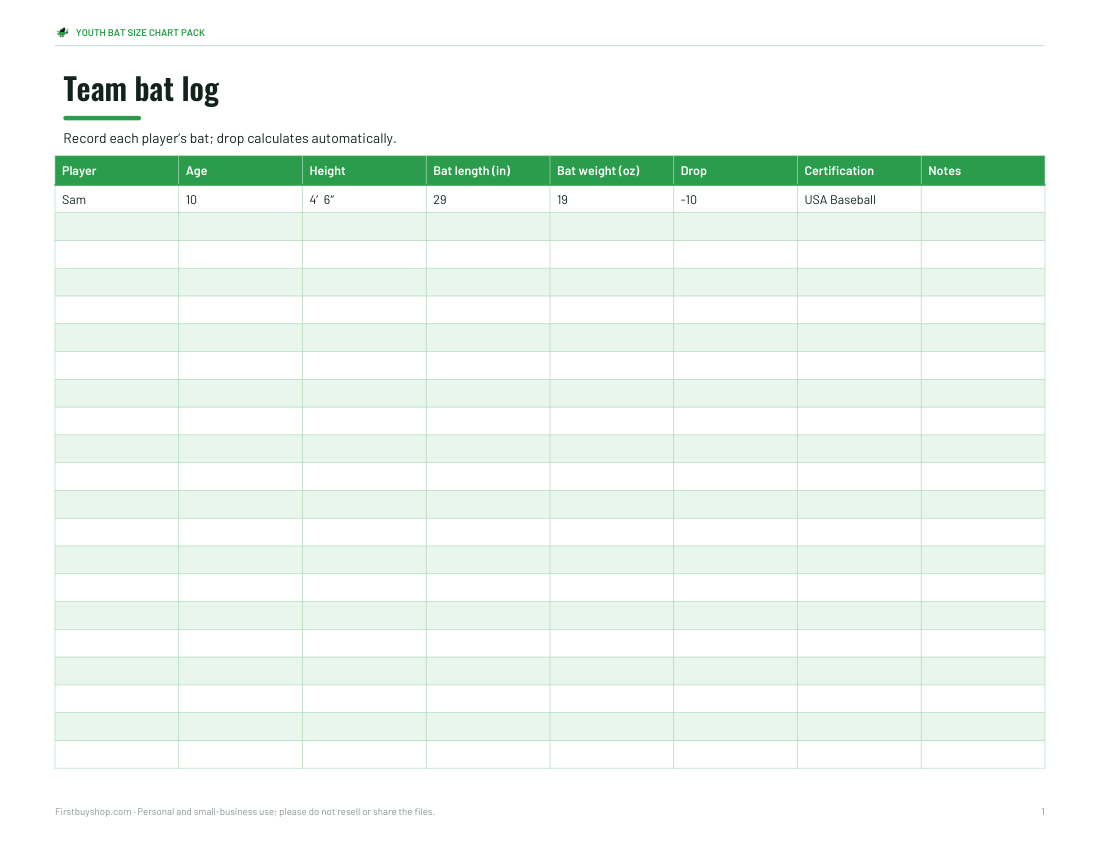
- Team bat log (XLSX)
Formats: PDF, XLSX, DOCX. Instant download after payment (link valid 72 hours, up to 5 downloads). AI-assisted: the templates were drafted with AI help and reviewed and laid out before publishing.
$5.00 USD, one-time 6 files · about $0.83 each
- Instant download
- 7-day refund
- Secure checkout by Stripe
7-day money-back guarantee. Full refund within 7 days of purchase, even after you download.
Free sample: Youth Bat Size By Age (PDF, 62 KB)
Full refund within 7 days — see the refund policy and license.
Free printables
Single sheets you can print right now, no sign-up. The full pack adds every sheet in one download plus the editable files.
 Printable Youth Bat Size Chart by Age
 Youth Bat Size Chart by Height
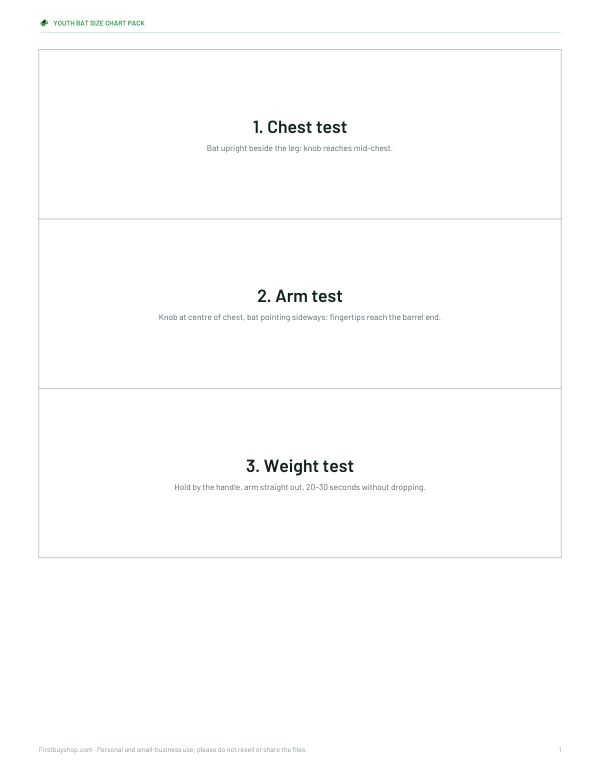 Printable Youth Bat Fit Test Cards
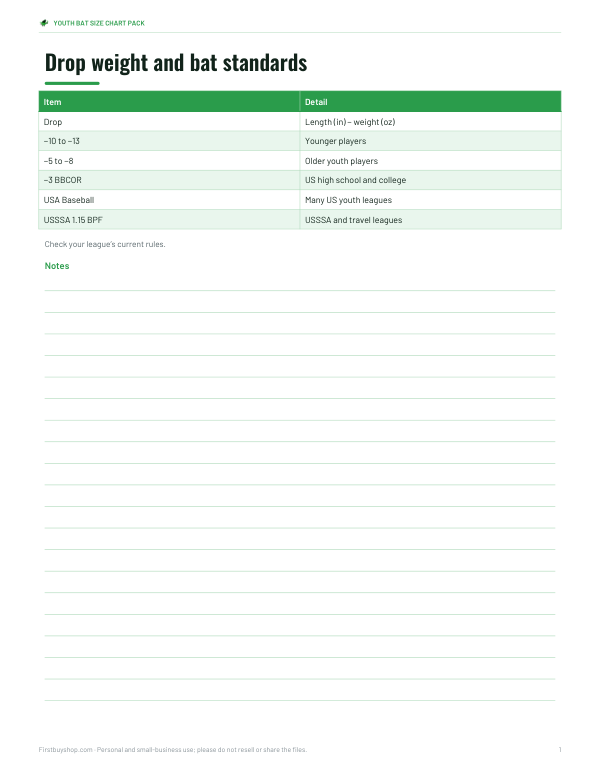 Printable Youth Bat Size Chart
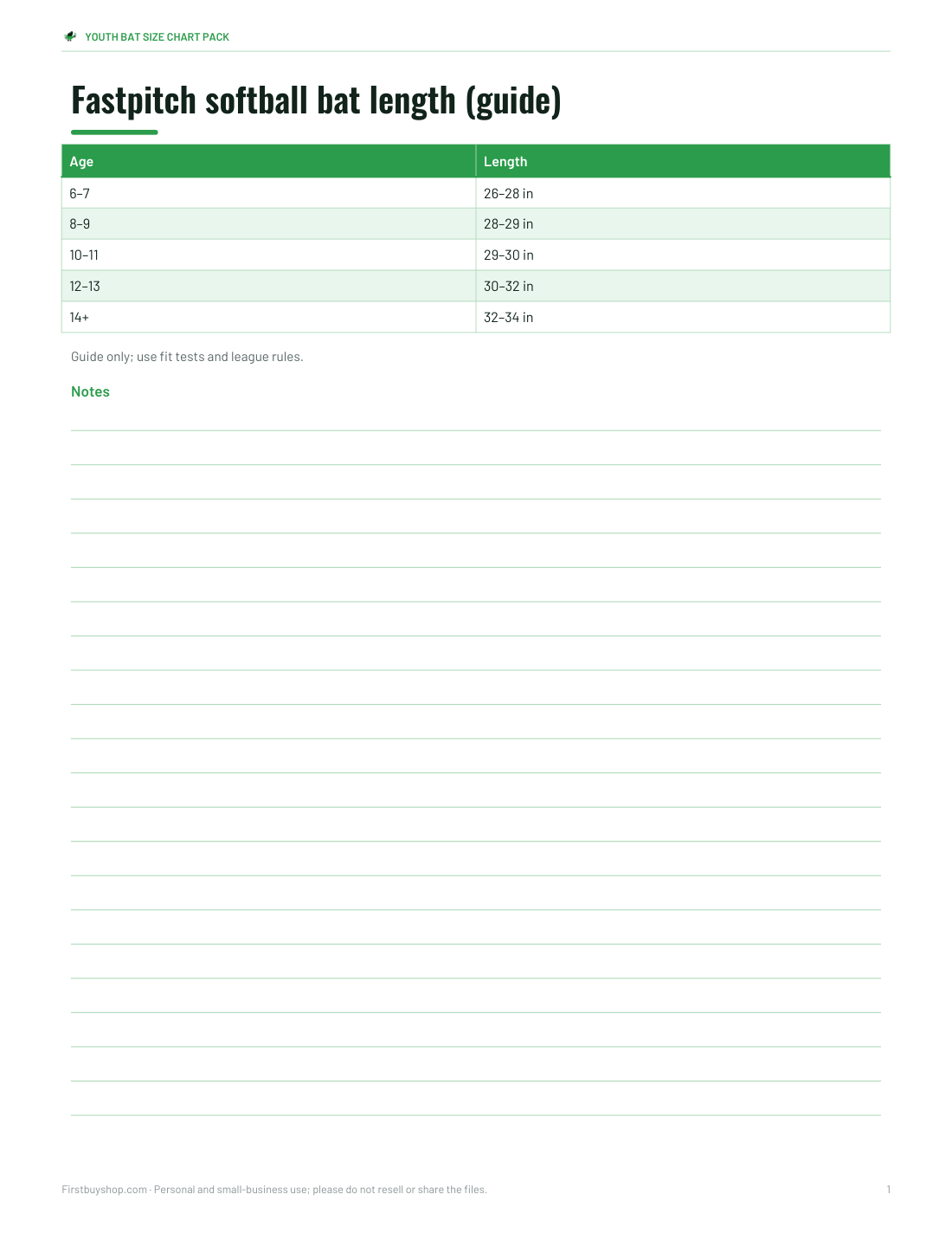
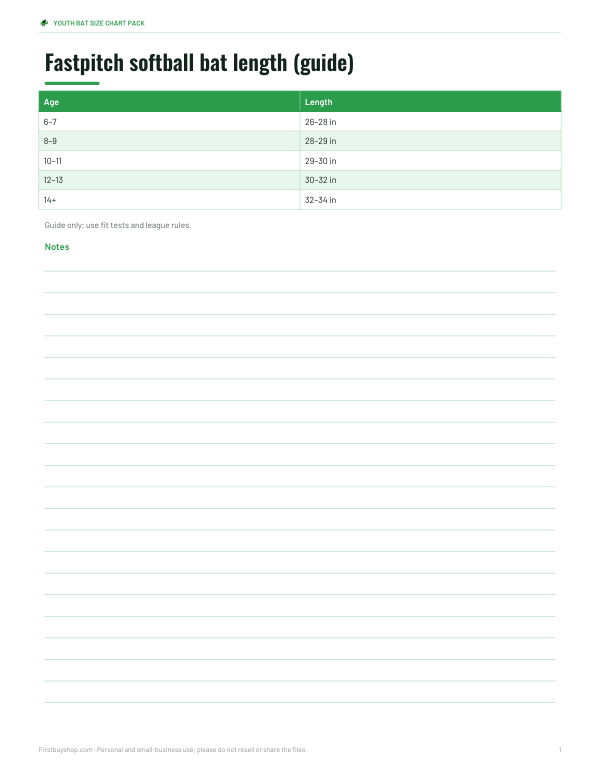 Printable Youth Fastpitch Bat Length Chart
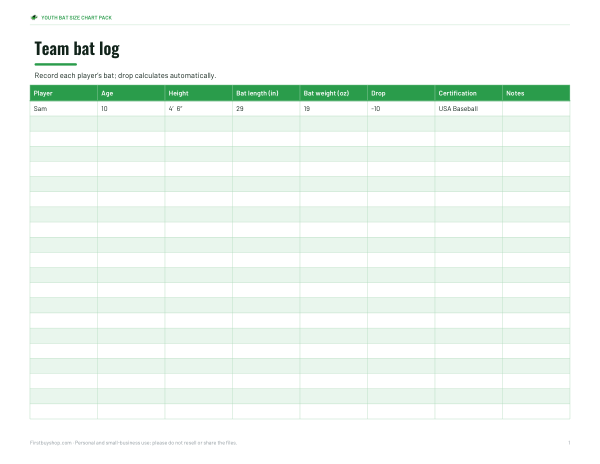 Printable Team Bat Log
Youth Bat Size Chart by Age
These are typical starting bat lengths; strength, height and swing control can change the best fit.
| Age | Typical length | Metric length | Notes |
|---|---|---|---|
| 4–5 | 24–26 in | 61–66 cm | Tee ball range |
| 6–7 | 25–27 in | 64–69 cm | Light swing first |
| 8–9 | 26–28 in | 66–71 cm | Check control |
| 10 | 28–29 in | 71–74 cm | Common youth range |
| 11–12 | 30–31 in | 76–79 cm | Fit test matters |
| 13–14 | 31–32 in | 79–81 cm | Rules vary |
| 15–16 | 32–33 in | 81–84 cm | League check |
| 17+ | 33–34 in | 84–86 cm | Adult-size range |
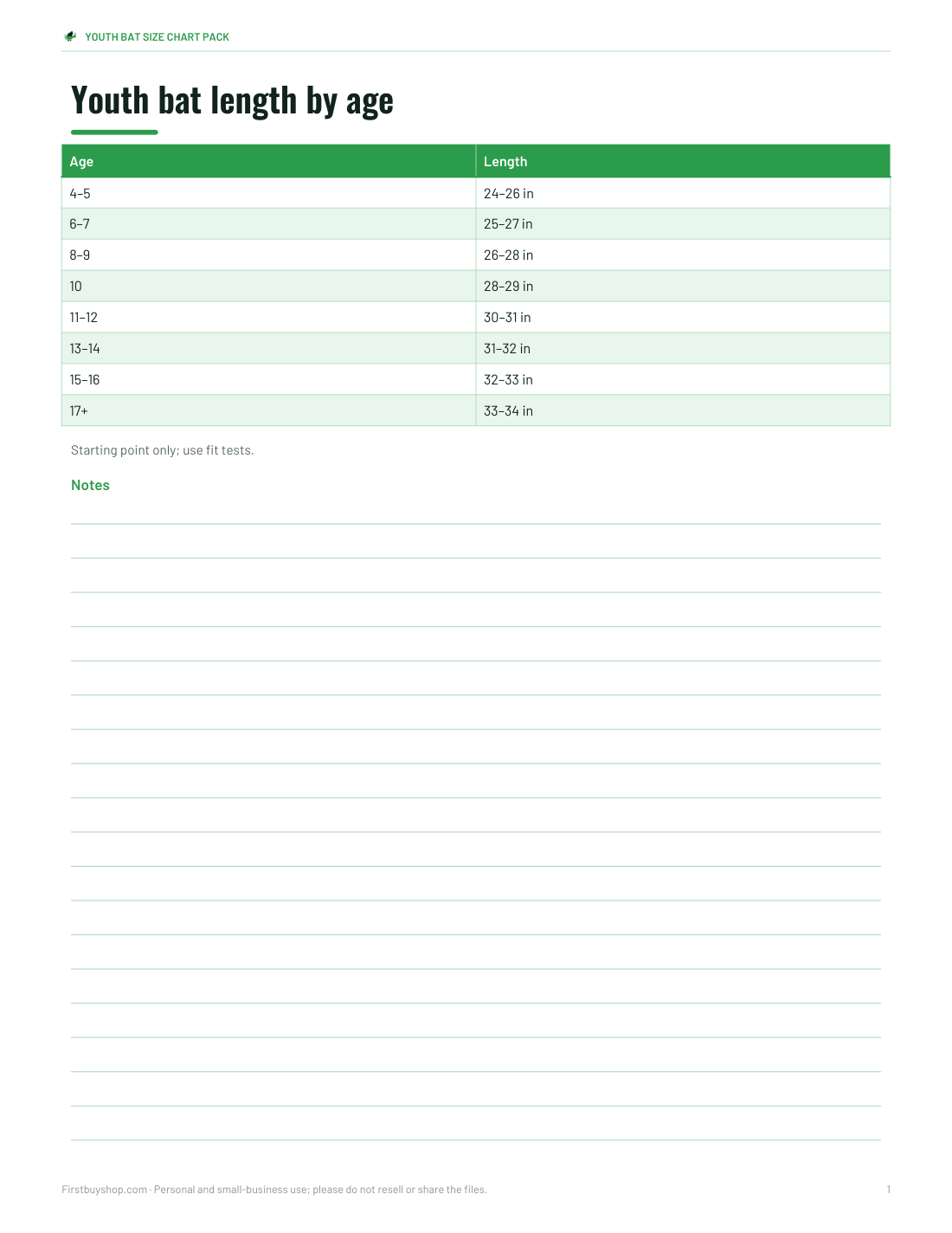
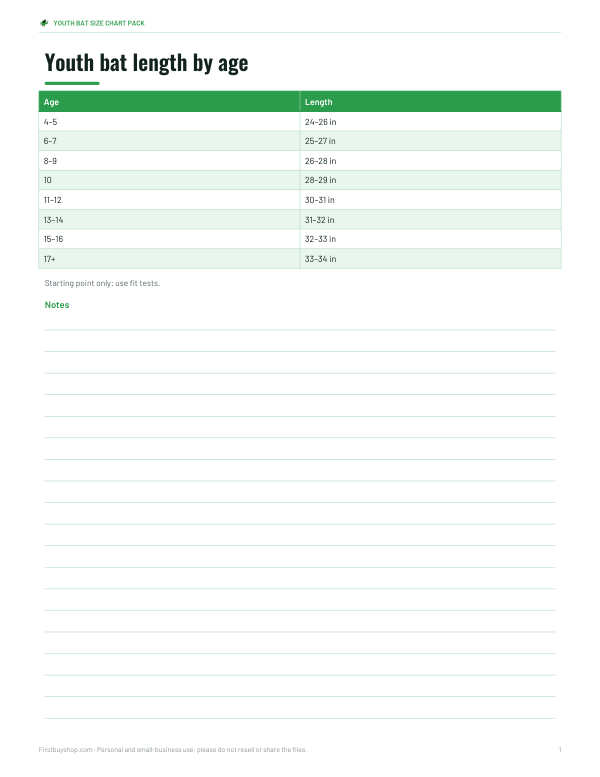
Youth bat length by age
| Age | Typical bat length |
|---|---|
| 4–5 | 24–26 in |
| 6–7 | 25–27 in |
| 8–9 | 26–28 in |
| 10 | 28–29 in |
| 11–12 | 30–31 in |
| 13–14 | 31–32 in |
| 15–16 | 32–33 in |
| 17+ | 33–34 in |
Age is a starting point only. Height and strength matter more, so use the fit tests below and, if possible, let the player swing a few bats.
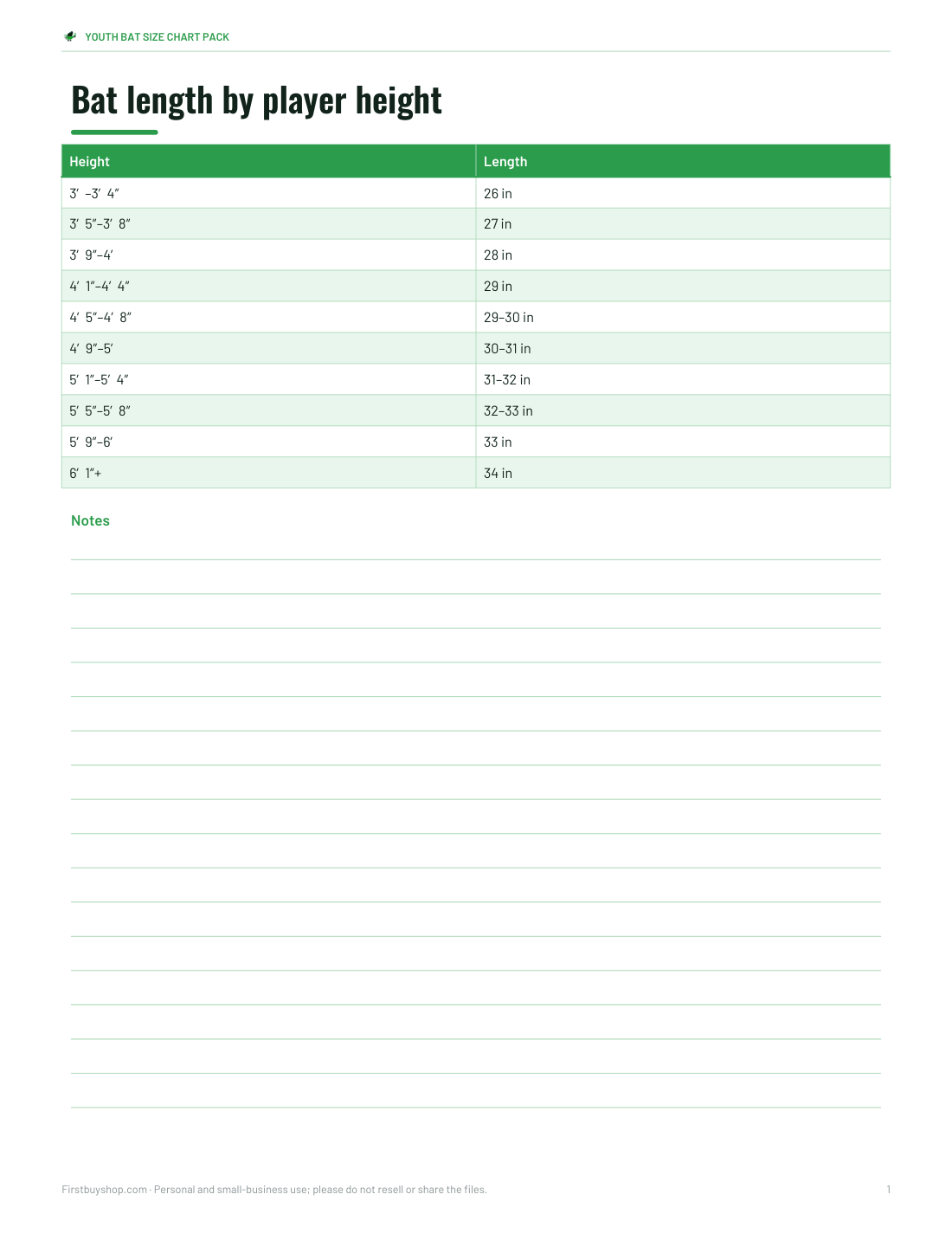
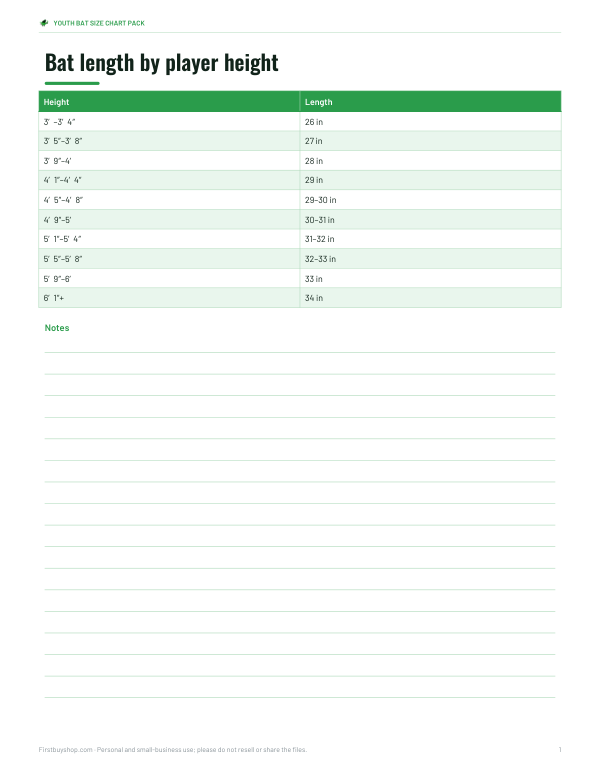
Bat length by player height (guide)
| Player height | Typical length |
|---|---|
| 3′–3′4″ | 26 in |
| 3′5″–3′8″ | 27 in |
| 3′9″–4′ | 28 in |
| 4′1″–4′4″ | 29 in |
| 4′5″–4′8″ | 29–30 in |
| 4′9″–5′ | 30–31 in |
| 5′1″–5′4″ | 31–32 in |
| 5′5″–5′8″ | 32–33 in |
| 5′9″–6′ | 33 in |
| 6′1″+ | 34 in |
Heavier, stronger players can often handle an inch more; lighter players may prefer an inch less.
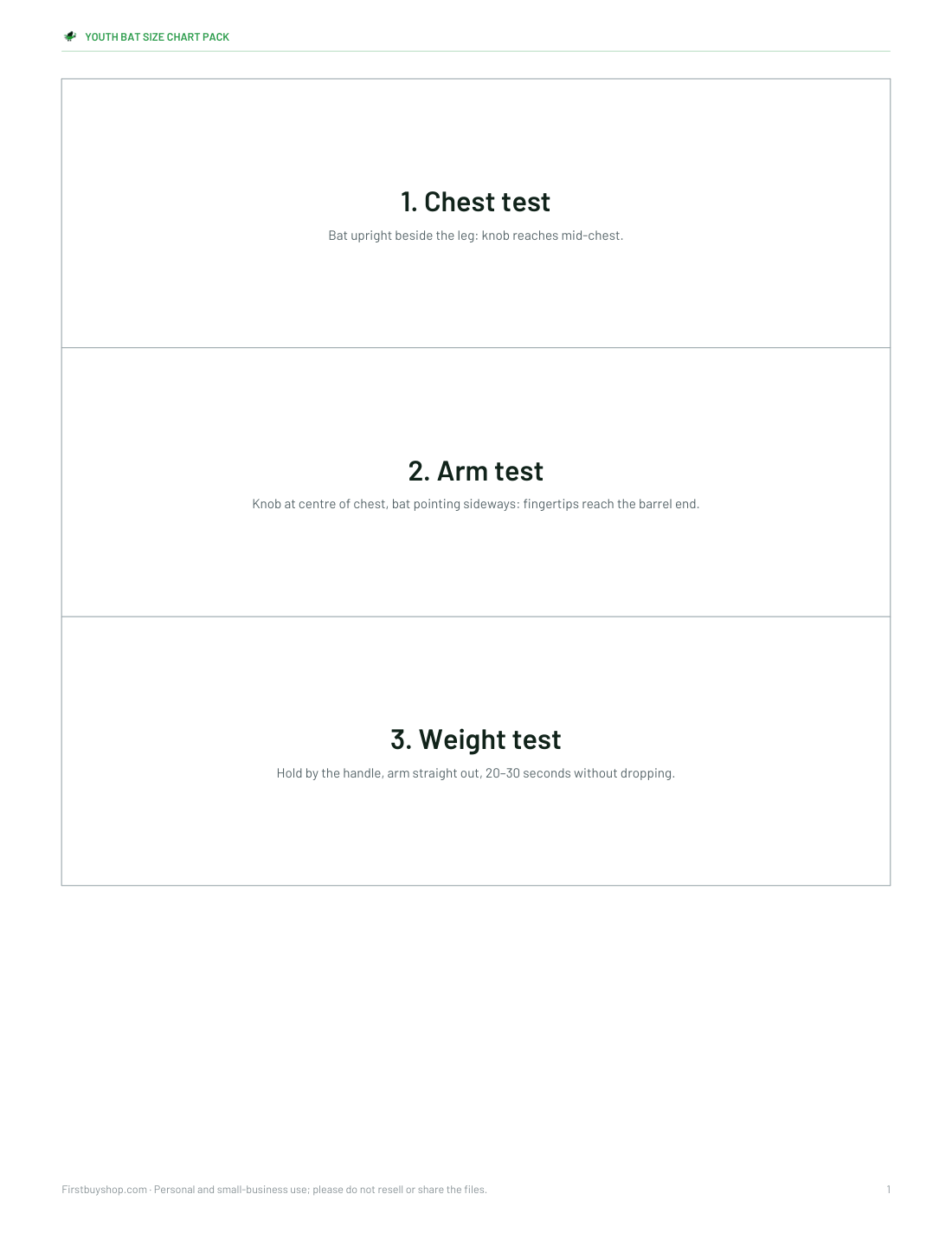
Three quick fit tests
- Chest test: stand the bat next to the player’s leg with the knob pointing up; the knob should reach about the middle of the chest.
- Arm test: hold the bat by the knob against the centre of the chest, barrel pointing out to the side; the player should be able to reach the end of the barrel with their fingertips.
- Weight test: the player holds the bat by the handle with one arm straight out to the side for 20–30 seconds; if the bat drops, it is too heavy.
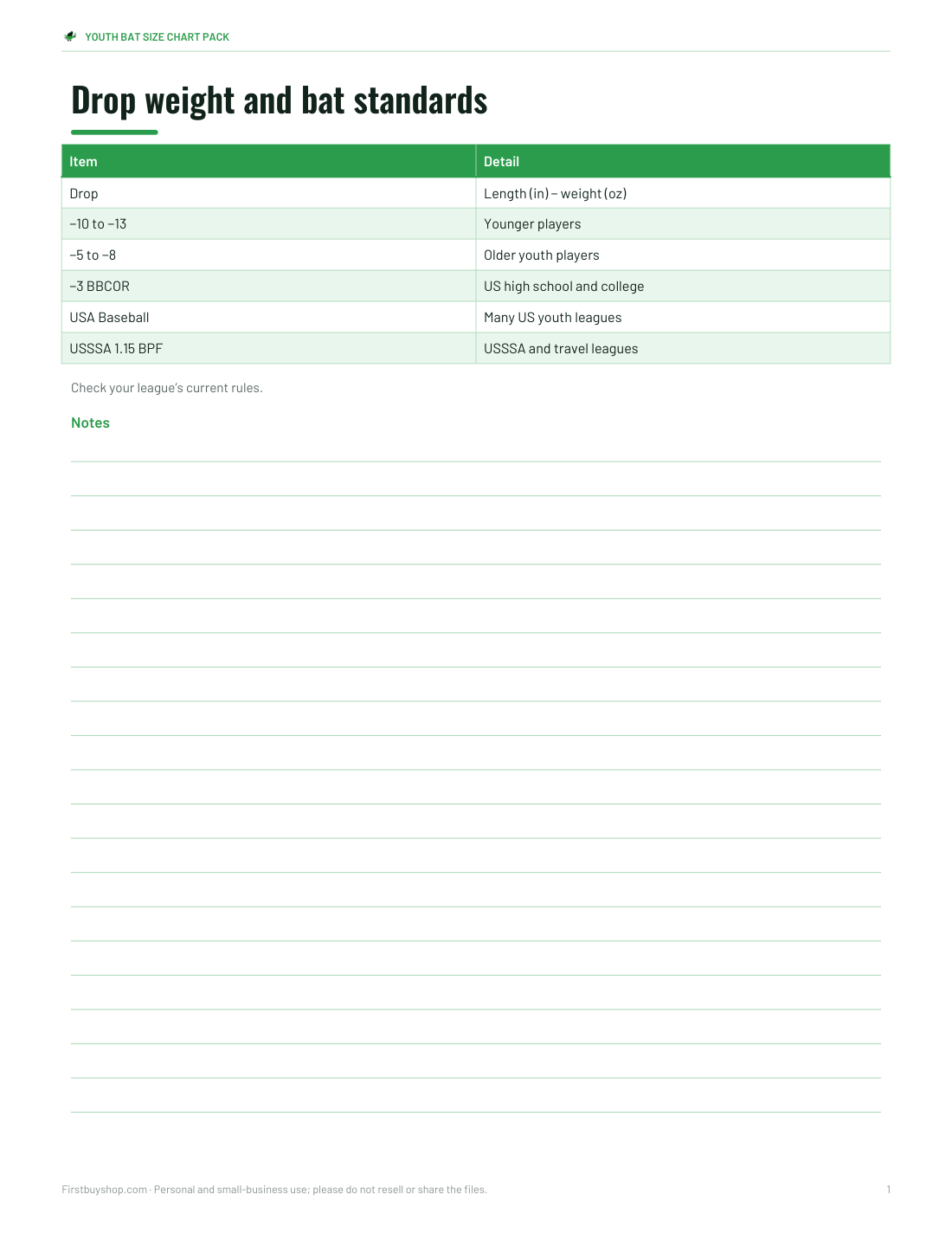
Drop weight explained
Drop weight is bat length in inches minus weight in ounces. A 30-inch, 20-ounce bat is a “drop 10” (−10). Bigger drops mean lighter bats that are easier to swing; smaller drops mean heavier bats with more mass behind the ball. Younger players usually use −10 to −13; older youth players move to −8 or −5; high school and college baseball bats in the US must be −3.
League bat standards
| Standard | Where it applies | Notes |
|---|---|---|
| USA Baseball stamp | Little League, Babe Ruth, Cal Ripken and others | Required by many US youth leagues; any drop allowed |
| USSSA 1.15 BPF | USSSA and many travel leagues | Check stamp; often allowed in tournaments |
| BBCOR .50 | US high school and college baseball | Must be −3 |
| Tee ball bats | Tee ball leagues | Usually 24–26 in, light and often USA stamped |
| Fastpitch softball | Softball leagues | Separate certifications; drops −8 to −13 common |
Rules change and differ by league. Always check your league’s current bat rules before buying.
Worked example
A 10-year-old who is 4′6″ and plays Little League. The age chart suggests 28–29 inches and the height chart 29–30 inches. At home, a 29-inch bat reaches the middle of their chest and passes the arm test, and they can hold a −10 (19 oz) bat out to the side for 25 seconds. The family shortlists 29-inch, drop −10 bats with a USA Baseball stamp.
What is in the pack
- Printable bat size charts by age and by height.
- Fit test instructions to print for the dugout.
- Drop weight and league standard reference.
- Softball bat size chart.
- Team bat log (Excel) for coaches: player, length, weight, drop and certification.
Formats
Print-ready PDF charts (US Letter; A4 with “Fit to page”) and an Excel team bat log.
Frequently asked questions
What size tee ball bat should my child use?
Most tee ball players use a 24–26 inch bat. Choose the lightest bat the player can swing level and under control.
Is a softball bat sizing chart different from baseball?
Youth fastpitch softball sizing often starts with similar length ranges, but the bat must meet softball league certification rules. Always check the league’s current bat requirements before buying.
What size bat for an 8-year-old?
A typical starting point for an 8-year-old is 26–28 inches. Use the fit tests and the player’s swing control to choose within that range.
What size bat for a 10-year-old?
Typically 28–30 inches, depending on height and strength.
What does drop weight mean?
Length in inches minus weight in ounces; a 30 in, 20 oz bat is −10.
How do I know if a bat is too heavy?
If the player can’t hold it out to the side for 20–30 seconds, or the swing slows, it’s too heavy.
Which bats are allowed in Little League?
Bats with the USA Baseball stamp; check current league rules.
Was AI used to create the charts?
The charts were generated by script and text drafted with AI assistance, then reviewed before publishing. League rules take priority.